Thursday, September 3, 2015

Voice those chords!

When playing anything with multiple voices in a chordal fashion, voicing is almost always an issue. A helpful image I like to give my students is to visualize holding and supporting a basketball with two hands out in front of you.  3-4-5 have more grip or support of the ball on the bottom and the thumbs which are higher up on the ball should be more relaxed and floating.

Picture above with a more relaxed expression :0).  This visualization will help achieve the right angle of the hands on the keyboard directing sound towards the outer voices for greater effect.

Sunday, June 14, 2015

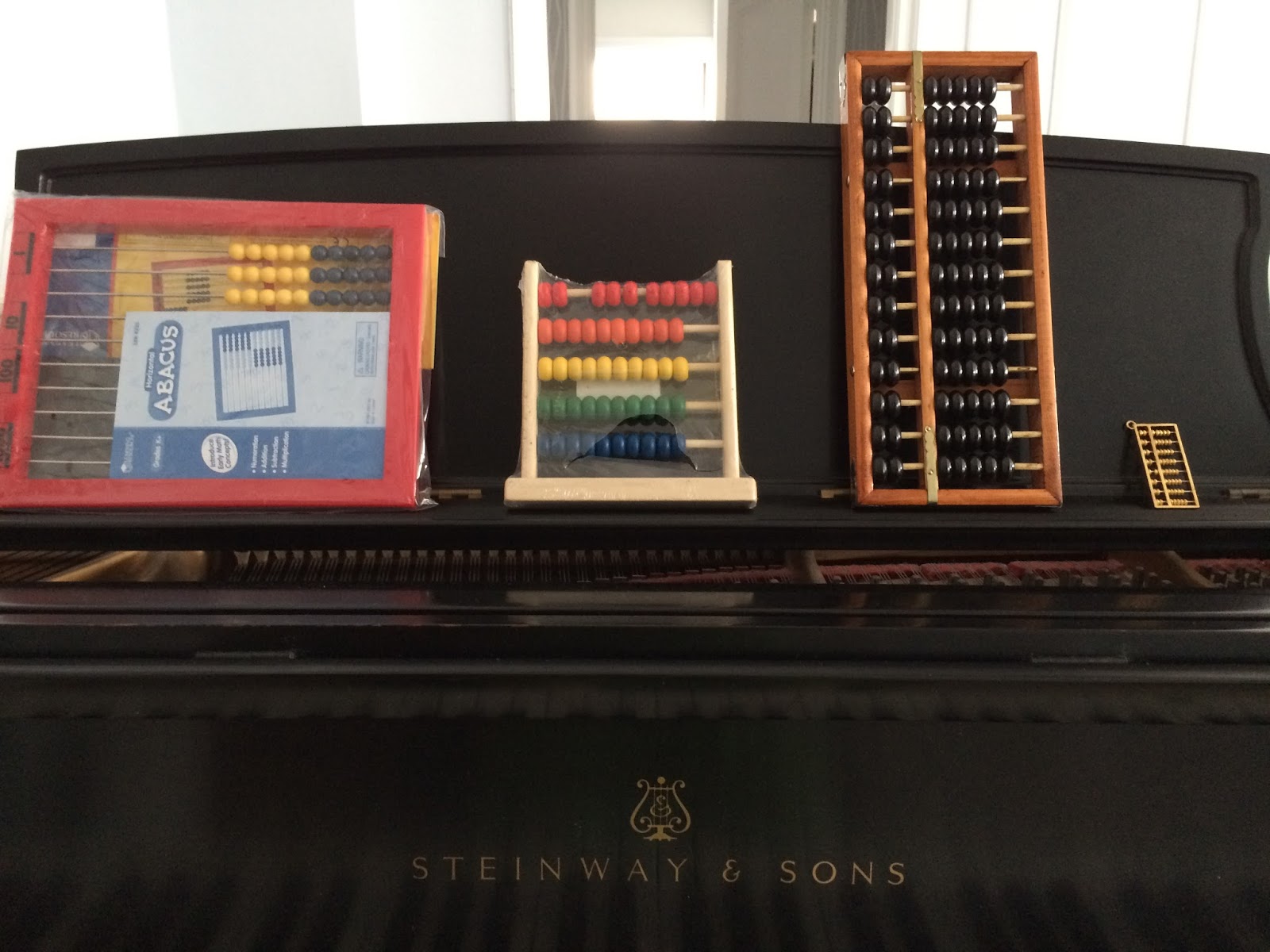
Visual Productivity-Pull out the abacus!

This week, I got a bit excited about abacuses.  Let me explain...


One of the reasons practicing remains difficult for students to gage is the lack of daily project completion/assignment confirmation for students.  Think about this - at school, kids routinely hand in daily assignments and get checks for completion or some sort of letter grade.  For piano, my proposal is for the student to use an abacus as a physical and visual measure of daily productivity.  There is an appropriate abacus for every level of student and engagement!

My youngest student, loves the rainbow abacus (second from the left).  She squeals in excitement in order to "move the beads!" For this student, the different lines and colors are great for breaking down the sections.  Say one is working on a 4 line, 16 bar piece. A single row could be a line, or even half a line (2 measures), right hand, left hand, or hands together.  By moving the beads, he or she stays on track and has both visual and physical confirmation of completion.  The top red line could be for linking two sections/lines together successfully or even playing through the whole piece. I swear that using this method may beat giving out stickers!

For the intermediate or advanced student (see 1st or 3rd abacus), each row can be applied towards running through a larger section; ie. an entire exposition, and the rows could be used to keep track of progress through several days or a week even or less if broken into smaller sections and used for different pieces. There really is no wrong way to use an abacus.

Have fun practicing and organizing everyone!


Tuesday, September 2, 2014

Metronome...Check!!

Today is the first official day of the school year (post Labor Day) in the city and for many parents, along with purchasing school supplies, make sure your child has the appropriate metronome handy!

Metronomes have gone through little change through the years.  I am forever buying new ones just because a metronome not in use does absolutely no good and the updated Seiko metronomes have a volume wheel that makes a whole lot of difference!

http://www.amazon.com/Seiko-SQ50-V-Quartz-Metronome/dp/B000LFCXL8/ref=sr_1_1?ie=UTF8&qid=1391705671&sr=8-1&keywords=metronome

The updated SQ50 (red wheel, far right), finally gives us volume control of the beeping sound without having to pay a fortune and resort to draining our iphone/ipad battery with a metronome app. The blue version, left side, carries a louder beep (2 different pitches) which is good for young kids and the one in the middle, though credit card size, has a higher pitch beep if you're into that short of thing. Finally, a metronome I can be happy turning on and playing along with!

What is the metronome for besides the obvious, keeping steady?  The metronome helps us diagnose the weaker areas of our playing so we can work for greater control.  It helps us iron out our kinks!  On a higher level, it fine tunes our listening and phrasing.  On a more basic level, it organizes our practice time more efficiently.

Happy practicing!!

Monday, February 4, 2013

Awareness-how does one actually get around?


When it comes down to it, there are really only 5 ways of getting around the piano keyboard no matter how intricate or expressive the passage; most of what actually is dependent upon the actual dexterity/flexibility of the palm. Knowledge of the actual process makes for more coherency in the playing, allowing one to concentrate rather, on the artistic purpose of the passage. 1. Contraction (shrinking of the hand smaller than actual finger interval span) 2. Expansion/reaching (opposite of contraction) 3. Jumping/skipping/hopping 4. Crossing over and under 5. Finger substitution (switching fingers when repeating a note shifts the hand's position)

Our Studio has relocated across the Park!

Last week was a big week! Our studio relocated across the park, and the first of the two pianos have arrived! The Steinway B has been put on the truck. It is due for a long drive...will keep you posted.
Meanwhile, the little one has already arrived.
and went in for a tune up on Superbowl Sunday.
And yes, congrats to our Superbowl champs! Go Ravens!!

Wednesday, December 19, 2012

Look how we've grown!

My beautiful extended New York family whom all came together last friday...I am so proud of you all. It warmed my heart to see and hear your beautiful performances. And yes, there were indeed some magical moments! Till next year!

Friday, October 5, 2012

Chamber Music Recital Tonight at 7 pm!

A Special Evening of Cello/Piano Music

Friday, October 5, 7:00 p.m.
Greenfield Recital Hall, The Manhattan School of Music (located on UWS at 122nd and Broadway, 120 Claremont Ave).

Program:
Beethoven 12 Variations on Handel's Judeas Maccabeus
Brahms E minor Cello Sonata
Shostakovich Cello Sonata


Admission is free


Ben Larsen, Cello
Alexis Zhu, Piano

Tuesday, September 11, 2012

What are we doing when we practice exactly?


On the most basic level, these are the things we are trying to achieve by practicing...

Advanced Pianist
1. Clarification of Ideas
2. Character
3. Control


Beginner-Intermediate
1. Sound, tone
2. Coordination
3. Comfort
4. Balance
5. Fluidity


Tuesday, December 13, 2011

Holiday Performance at Steinway Hall, NYC


This was the grand finale to our Student Holiday Recital at Steinway Hall, NYC. It was a very special night of music making and quite a showcase! Thanks to all the families and students for their hard work and beautiful performances! It is such a treat as a teacher to see how each and everyone of you has grown and developed this past semestar. See you all in the New Year!

Monday, November 14, 2011

The Working Unit

Most students make the mistake and waste countless amounts of time playing through versus practicing. They fail to realize that things need to be fixed or examined in smaller sections than what most students take on when "playing through".

A run-through/play through involves a larger unit and consists anywhere from 8 bars to an entire movement or piece. While run-throughs are necessary, by themselves, they are not a sufficient or productive way to practice and learn material. Run-throughs should take up less than half of the practice time.


The working unit, on the other hand, allows the pianist/student to focus and fully comprehend the material. Like phone numbers and clumping, the human brain can only fully comprehend so much material at a time. As such, the base of the working unit is usually 2 bars, sometimes 4 or 8, and always ends on the downbeat of the following bar. For example, a 2 bar working unit ends on the downbeat of bar 3. By practicing until the next downbeat, the pianist avoids the faux paux of ceaseless hesitations, strange rubatos when linking together complete phrases, the unnatural stopping-starting created by technical deficiencies.

Tuesday, October 18, 2011

Chopin-How to get those improvisational and notoriously difficult florid passages seamless and fluid

Thought for the Day...

We know we all struggle to make fluid those odd multi-note florid passages in Chopin which tend to go on forever. Instead of using the heavier dotted-note rhythms to make such passages even, try stopping on every note in the sequence instead.

For example - if the passage is 16 notes long, then stop on note 2, 3, 4, 5, 6, 7, 8, etc. 16. This allows you to explore the in and outs of the keyboard and naturally molds your hand shape to the unique shape of the passage, making the figures easier to shape over the underlying harmony later on.

Friday, September 9, 2011

Listening and Creating Your Own Personal Sound World

An inspiring, eye-opening lecture about how to listen given by Evelyn Glennie. This will transform your concert going experience and the way you respond to music. What every artistic teacher is trying to impart to their students...

Evelyn Glennie shows how to listen | Video on TED.com

Tuesday, August 23, 2011

What can you get done in 20 minutes?


A simple test to check how productive you are really: set a timer to 20 minute increments to monitor your practice throughout the day to see what you are able to accomplish in that amount of time. Revealing, no?

The timer can also be used to organize your practice time between, sections, pieces, etc, so that you don't get stuck on a piece/page and forget to move on.

Photo: Practicing kit: hairclip, Starbucks coffee from downstairs, trusty debate timer, klm collectible porcelain dutch house, pile of scores, backdrop-NYC!

Wednesday, July 27, 2011

How to Practice Scales


Everybody wants to know how to practice scales. Quite simply, most students
do not play scales on a routine basis because they simply have no idea why exactly they are asked to play them.

Scales are a great way to warm up not just physically, but to help prepare the mind for the appropriate stylistic aesthetic ahead. In other words, scales can be used as a tactile and aural preparation for the style of piece about to be played.

For the Intermediate player, transfer student, or even advanced player, I teach my students to practice scales four distinctive ways and as needed as listening exercises to warm up before learning a piece of music. These four types of scales are of course, simplifications which I have arrived at for ease of use and explanation. This is just one way to introduce a basic variety of touches that every pianist should consistently have at their disposal.

In order to listen more carefully, practice hands separately for this purpose. Please see above for my "Scales in the Style of...."


Sunday, July 17, 2011

Books to Improve Reading for Beginners

Summer is a great time to improve reading as well as sight-reading skills.


The books that I commonly use to improve reading for beginners is the Sight Reading & Rhythm Everyday Series by Helen Marlais and Kevin Olson. I usually will use levels 3A-5 to explain and revisit concepts as needed. Beyond that, students should be sight reading in the actual repertoire.

See my Sightread in Keys post

Monday, July 11, 2011

Common Pitfalls to Avoid when Playing Mozart


The deceptively simple textures of Mozart are hazardous for even the most seasoned performers

Two things often found in intermediate performances of this composer.

1. Rushed ornamental figures. Decorative small notes should always be played with ease (almost languidness) and never on the heavy side. In other words, never squeeze the florid notes.

2. 16th-note accompanimental figures (usually l.h), usually sound too groupy. These figures rather, should follow a longer line and go on forever (carry a lyrical momentum).

Other helpful hints
1. Listen so that the horizontal line or motion goes all the way to, or even through the rest.
2. Phrase through the articulation. Do not let it break the shape of the phrase.

Saturday, June 25, 2011

Favorite IPAD apps/technology and how it has changed the piano studio


This past year, one of my favorite questions that I get from my students are, what are your favorite iphone/ipad apps?

Besides the usual keyboard, (virtuostic pianist app), things have taken off so far and beyond that (great for ear training, theory assignments, btw) to have substantially transformed the way we think about music study on the most basic level.

One of my favorite apps is the pdf-notes app on the ipad which allows you to mark up your music and saves you from lugging scores around.

I also am a big fan of gmail video chat which enables me to check in and even teach my students occasionally online. The vtok ipad app enables video conferencing on my ipad 2 with gmail video chat.

Both tools have greatly altered the way I think of "traditional music study" as well as a way to enhance the limitations of the "traditional weekly lesson format."

Kudos to technology!